The RISC-V Coprocessor in Nordic’s nRF54L Series - A Medical Device Perspective
Exploring the architectural advantages of offloading deterministic tasks to a secondary core.


Exploring the RISC-V Coprocessor in Nordic’s nRF54L Series, A Perspective from Medical Device Architecture
In many active medical devices, wireless communication and time-critical system functions are intentionally separated into different processing domains.
Connectivity stacks, particularly BLE, introduce interrupts, timing variability, and software complexity that can interfere with deterministic tasks such as signal acquisition, therapy control, or tightly timed stimulation waveforms. For this reason, it has been common in several device architectures to separate responsibilities across multiple processors: one dedicated to communications and application logic, and another responsible for critical timing-sensitive functions.
Recently, Nordic Semiconductor introduced the Fast Lightweight Processor (FLPR) integrated in the new nRF54L series. While the presentation focused on embedded design and IoT applications, the architecture also raises interesting considerations from the perspective of medical device system design.
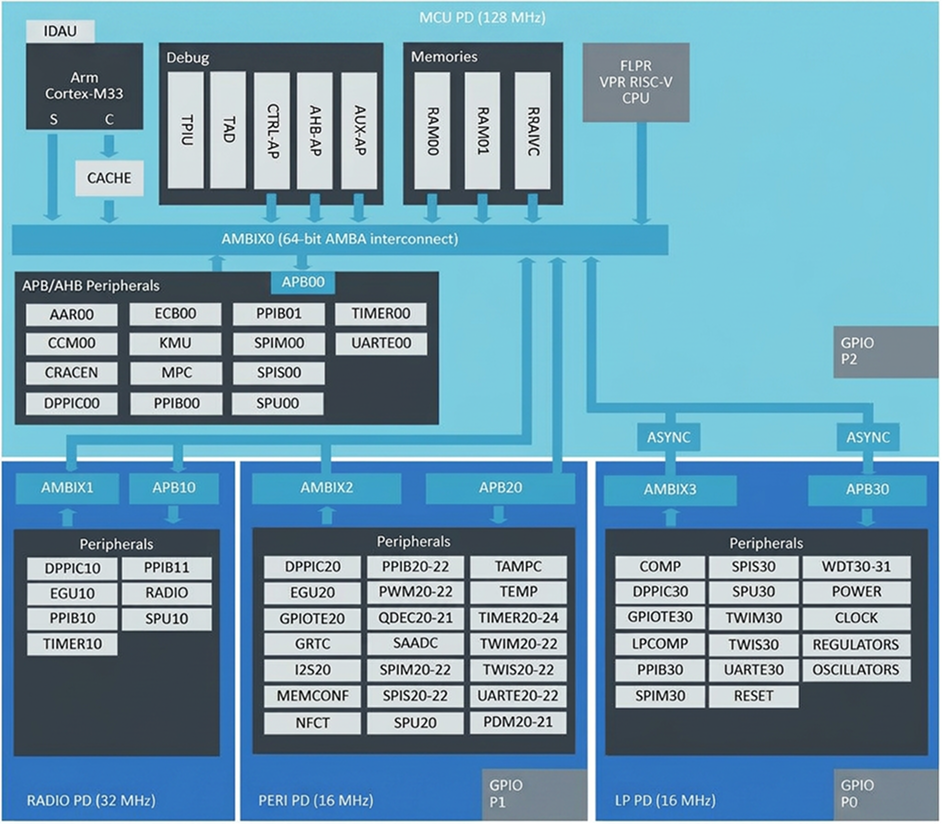 nRF54L Block Diagram showing the dual-core architecture.
The nRF54L architecture combines a Cortex-M33 application processor with a RISC-V coprocessor implementing the RV32EMC instruction set. This secondary execution domain can be used to offload tasks from the main processor or emulate additional peripherals through software.
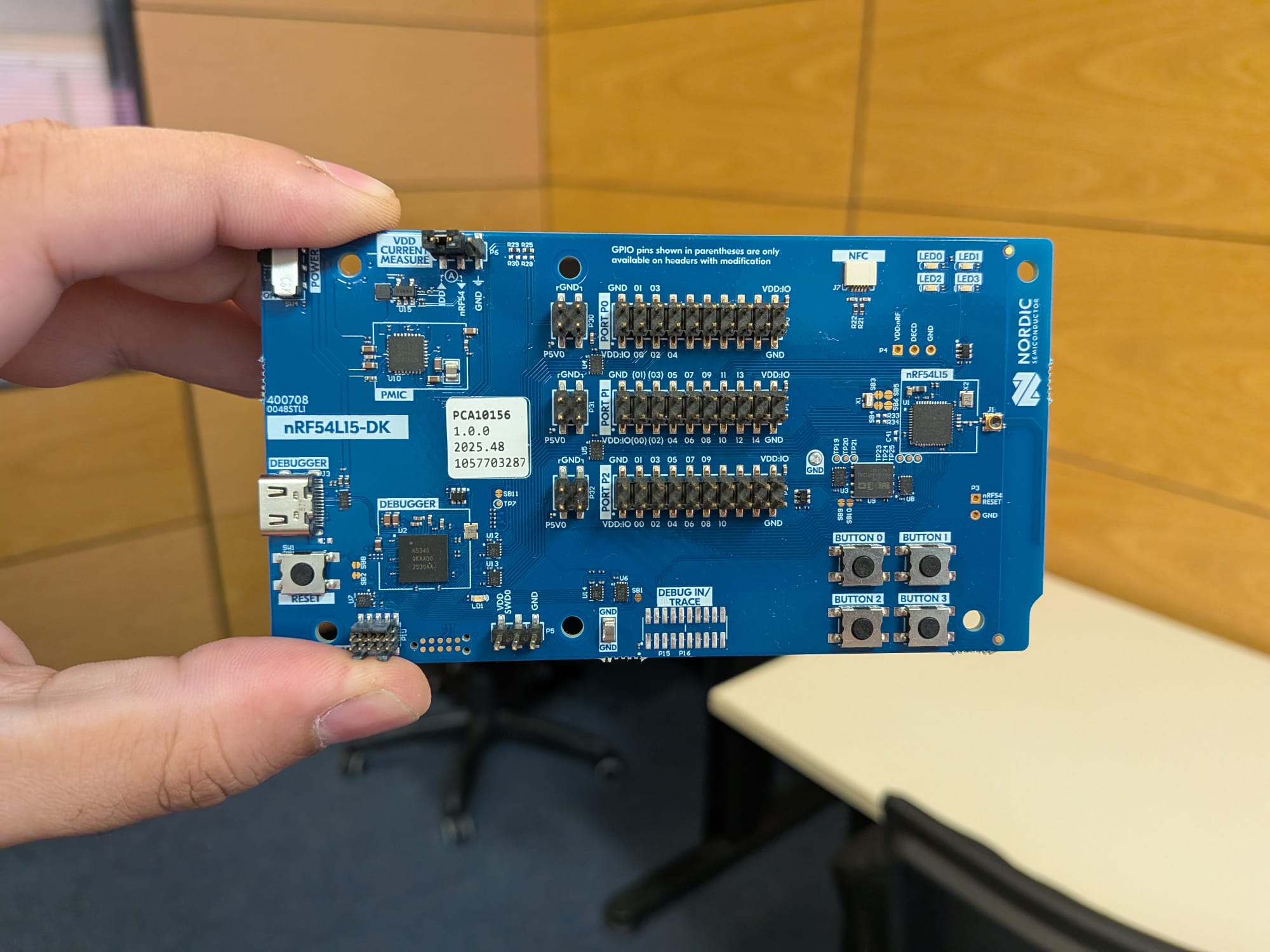 NRF54L Devkit
From a system architecture standpoint, this creates a structure where the main processor can focus on connectivity and higher-level application logic, while the coprocessor handles deterministic or time-sensitive workloads.
In practice, this type of partition can be useful for tasks such as:
- Deterministic waveform generation for stimulation systems control
- Time-sensitive GPIO or control loops
- Signal acquisition or preprocessing
This coprocessor can execute independent workloads while the main CPU handles BLE communication, preventing radio activity from corrupting timing-sensitive operations, a situation that many embedded engineers have encountered when mixing communication stacks and precise signal control.
From our industry's perspective, this architectural model is particularly interesting because it enables, within a single SoC, the separation of responsibilities that has traditionally required two separate microcontrollers.
That said, there are also practical considerations to evaluate. The FLPR is not an independent processor that can operate autonomously; it must be started and managed by the main Cortex-M33 core. In addition, careful memory partitioning is required to avoid bus contention between execution domains.
Despite these considerations, the architecture itself is an interesting step toward more flexible embedded system partitioning. The ability to introduce a secondary execution domain inside a single SoC opens opportunities to simplify system architectures while maintaining separation between communication layers and deterministic control functions.
As with any architectural decision, the real value will depend on how these capabilities are integrated into the overall system design.
Disclaimer
The information contained in this document is provided for educational and informational purposes only. While every effort has been made to ensure accuracy, we make no representations or warranties, express or implied, regarding the completeness, accuracy, reliability, or suitability of the information presented. Any reliance placed on this material is strictly at your own risk. This document does not constitute professional, regulatory, or legal advice. Readers are encouraged to consult qualified professionals and applicable regulatory authorities before making decisions based on the information provided. No proprietary product designs, confidential information, or client-specific technologies are disclosed or implied in this document. All product names, logos, brands, trademarks, and registered trademarks mentioned are the property of their respective owners. They are used for identification purposes only, and their inclusion does not imply any affiliation with or endorsement by the respective owners.In no event shall Montevideo Medical Devices, its affiliates, or its representatives be liable for any loss or damage, including without limitation indirect or consequential loss, arising from the use of or reliance on the information contained in this document.